
Read Warren Property Tax Records
Two Warren offices split the tax-records work. The Board of Tax Assessors decides fair market value, assessed value, taxability, exemptions, and the parcel characteristics on the assessment record. The Tax Commissioner then bills and collects. Read the assessment first. Turn to the bill second. A payment gateway shows what is due and takes money, but it is no substitute for a historical ownership or tax-roll search through the property records themselves.
| Field | What It Shows | Where |
|---|---|---|
| Fair market value | County estimate as of January 1 | Board of Tax Assessors |
| Assessed value | Forty percent of fair market value under Georgia law | Board of Tax Assessors |
| Land and improvements | Components supporting the total | Assessment record, exact labels unverified |
| Exemptions | Relief applied under a qualified program | Assessor and Tax Commissioner forms |
| Bill and payment | Amount charged and collection status | Tax Commissioner |
| Tax district | Local district context used with millage | Parcel and tax records |
Georgia law generally assesses real property at 40 percent of fair market value under O.C.G.A. §48-5-7. Governing bodies then set the millage, which the county applies after exemptions and other lawful adjustments. Neither the assessed value nor the bill is a sale price.
Warren Assessor and Collector Roles
The Chief Appraiser sits in Room 105 at 521 Main Street, reachable at 706-465-3321 and Assessors@warrencountyga.gov. Public hours run Monday through Friday, 8 AM to 5 PM. Parcel traits, value, taxability, notices, and appeals all start there. The Tax Commissioner occupies Room 108, at 706-465-2231 and Tax@warrencountyga.gov. That office keeps the digest. It issues bills, handles collection, homestead applications as directed, payments, and disbursements. One division of labor matters: the assessor neither sets the millage rate nor collects the bill.
Warren's 2026 Revaluation Notice
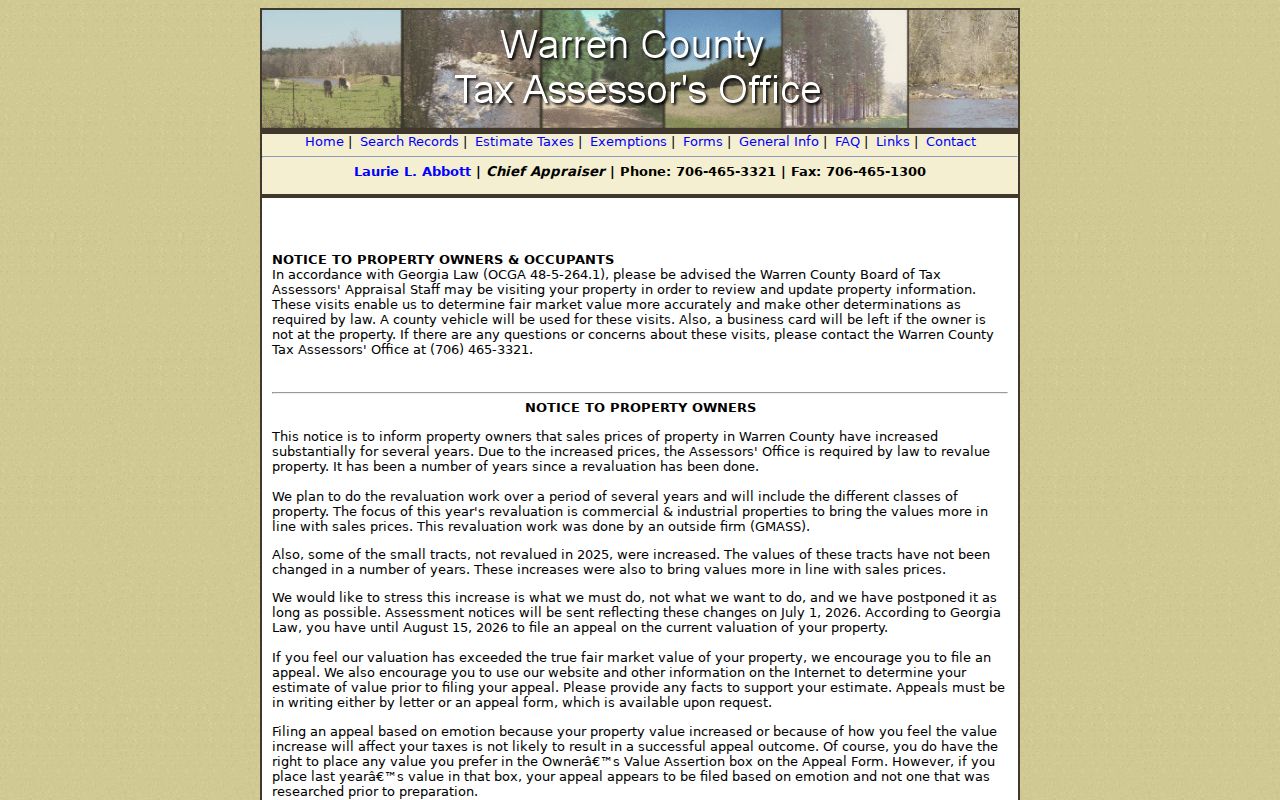
The Warren qPublic notice explains that sales prices climbed after years of postponed revaluation. For 2026, the work centers on commercial and industrial property. Outside help comes from GMASS. Some small tracts skipped in 2025 also rose. The notice explains a changed assessment. It cannot settle whether a particular parcel's value is right.
Assessment notices were scheduled for July 1, 2026. The stated appeal deadline was August 15, 2026. A letter or form works, and factual value support is recommended. Read the notice tied to the parcel before acting. Each deadline belongs to its own assessment cycle.
Warren Exemption Forms and Proof
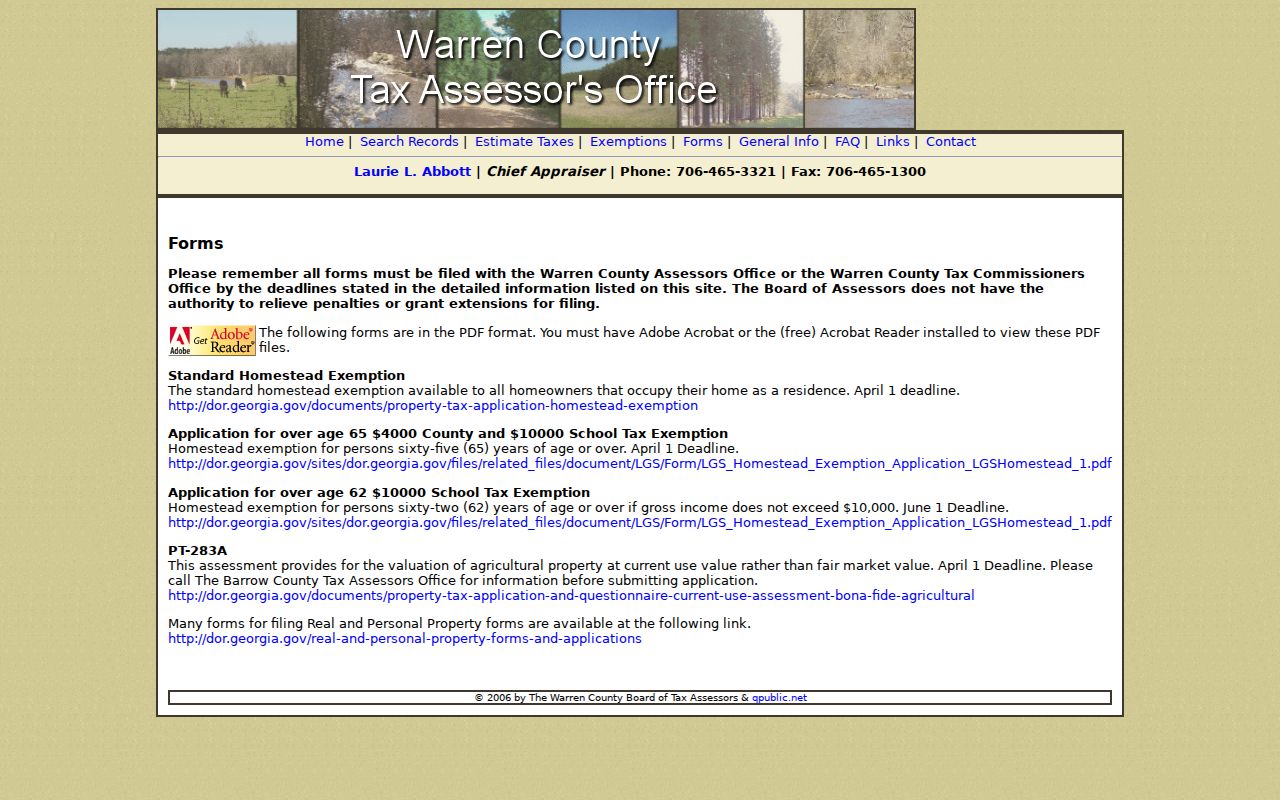
The county's qPublic forms page is the official starting point for assessment forms and exemption material. Eligibility turns on the program and the evidence behind it. An exemption can shrink taxable value. It cannot change the recorded deed or prove who occupies the land now.
Ask the assessor or Tax Commissioner which office receives the form, what proof must ride along, and which deadline controls. Keep a filed copy plus proof of delivery. The forms page identifies the county's route; the office confirms current requirements.
Check a Warren Tax Bill
The county links a Government Window payment portal, which serves payments rather than a free historic roll or owner-search database. Begin with parcel and assessment data instead. Then use the Tax Commissioner for the current bill, payment status, and prior-year questions. Confirm any processor charge before paying online.
- Find the parcel through qPublic or call the assessor when the vendor application is blocked.
- Confirm fair market value, assessed value, tax district, and exemptions on the assessment record.
- Use the Government Window payment route for current payment, or contact the Tax Commissioner for bill history and status.
- For delinquency, ask whether a tax execution, levy, notice, redemption issue, or sale process exists, then cross-check recorded instruments.
- Assessed value
- The statutory portion of fair market value used in the tax calculation.
- Millage
- The rate applied to taxable value; one mill is one dollar per thousand dollars.
- Homestead exemption
- Qualified tax relief associated with a principal residence under the program's rules.
- Tax execution
- A recorded collection claim for unpaid tax that requires current status review.
Trace Delinquent Warren Taxes
Warren publishes no dedicated online tax-sale roster. The Tax Commissioner is the first stop for delinquent status and sale procedure. Search the Clerk of Superior Court and GSCCCA for a tax execution, lien, lis pendens, judgment, release, or sale-related deed. Pending litigation runs through PeachCourt for Warren Superior Court.
Public notices may carry a required sale notice. But the county page is not a complete tax-sale index. Compare the tax account, the recorded execution, redemption status, the notice, and the final deed. These questions carry legal deadlines, so verify current procedure with the office or counsel.
Note: A payment page alone cannot establish whether a recorded execution, pending sale, redemption right, or court case remains active.
Warren Tax Records Can Lag Deeds
The assessor's owner field exists for tax administration. A deed recorded after the roll closes may not show up until a later refresh. Warren publishes no set nightly or monthly update interval. Before treating a mismatch as an error, compare the recording date with the assessment year.
The mailing address adds its own twist. It may name a trustee, attorney, lender, business office, or other tax recipient. That is not proof of occupancy. For today's conveyance facts, trust the recorded deed. For value and exemptions, rely on the assessor's property records.
Audit a Warren Delinquent Account
Give any status check a clear date. Ask the Tax Commissioner for the tax years involved, principal and added charges, whether an execution was recorded, and whether a payment plan, levy, advertised sale, or redemption issue is pending. Then check the clerk's index for a later cancellation or release. Tax accounts change after payment or correction. The recorded trail may still need a separate satisfaction filing. An old notice never describes the account today.
Parcel splits and mergers create another mismatch. An older deed may describe a larger parent tract, while the current assessment uses new parcel keys and divided values. Ask the assessor to link old and new accounts. Follow the change with the plat and legal description. Never add two assessment values without checking whether one replaced the other.
Request Warren Tax Data Offline
Sometimes the online tools leave a question open. The record custodian can help instead. The assessor explains assessment data, parcel traits, exemptions, and notices, while the Tax Commissioner handles bills, collections, and payment status. Written requests should follow the Georgia Open Records Act. Name the parcel or address, the tax year, the record type, and the electronic format you want.
Agencies generally must respond within three business days. That response may be production, an availability notice, a cost estimate, or a cited exemption when immediate production is not possible. The law covers existing records, not new analysis. Ask for a tax digest row, a notice, a bill, a payment ledger, an exemption record, or specific data fields. Attorney General guidance makes the first fifteen minutes of search and retrieval free. Later labor and copy charges may apply.
Appeal a Warren Assessment
A Warren County appeal can challenge value, taxability, or uniformity. Read the current assessment notice first. Identify the stated deadline. Then submit a letter or the available form through the county route. Strong support includes comparable sales, a recent arm's-length sale, photographs, measurements, condition evidence, or proof that parcel characteristics are wrong. Keep the issue factual and parcel-specific.
The Clerk of Superior Court administers Board of Equalization functions. The assessor handles the assessment record and the initial appeal process. Ask which stage applies. Preserve proof of timely filing. An appeal of value will not change the deed or the tax bill's payment status.
2026 appeal window. Warren's posted schedule set notices for July 1 and appeals due August 15, 2026. Verify the deadline printed on the parcel's own notice.
Build Warren County Appeal Evidence
An appeal works best when every claim points to a record. Start with the notice and parcel card. Check land area, improvement details, use class, and exemptions. Also review the values assigned to land and buildings if shown. The live qPublic view may not display its field labels. Ask the assessor to identify the field and tax year. Do not borrow a label from another county.
Choose comparable sales with care. Use sales close in time and reasonably similar in location, use, size, age, and condition. Confirm each sale through the deed trail where possible. A consideration figure or assessor sale line may hide unusual terms. These include a partial-interest transfer, an estate deal, or a combined-parcel sale. State why each comparison supports the requested value.
Uniformity is separate from market value. A uniformity claim says similar Warren County parcels are assessed on an inconsistent basis. Identify those parcels and compare the same fields. Taxability has its own facts, such as classification or exemption eligibility. Keep each ground clear. Then the assessor and any Board of Equalization review can address the issue.
The 2026 county notice adds local context. Notices were scheduled for July 1, and appeals were due August 15. Commercial and industrial work was a focus, with GMASS help. Some small tracts not revalued in 2025 also increased. Those facts never replace the deadline on your own parcel's notice. Preserve the notice, appeal, exhibits, and delivery proof.
An appeal alone changes neither the recorded deed nor the collection record. Keep payment, billing, and delinquency questions with the Tax Commissioner. Send owner or legal-description corrections to the proper assessment or recording source. A deadline or hearing right may be unclear. Ask the assessor which current form, filing method, and review stage applies.