
Decode Warren Deed Records
The Warren County Clerk of Superior Court serves as the county's recorder-equivalent. Its deed records sit beside plats, security deeds, liens, judgments, easements, rights-of-way, and releases. A recorded deed proves an instrument was filed. It also names the parties and gives the land description. It fixes the book and page where the deed lives. The deed type helps explain what kind of transfer happened. But recording alone never promises clear title.
| Deed Type | What It Does | Common Use |
|---|---|---|
| Warranty deed | Conveys land with stated title promises | Ordinary arm's-length sale |
| Limited warranty deed | Limits the grantor's promises | Business or estate transfer |
| Quitclaim deed | Transfers only the interest the grantor has | Interest cleanup or family transfer |
| Executor or administrator deed | Conveys through an estate representative | Probate-related transfer |
| Security deed | Secures a debt against real property | Financing, not a sale by itself |
An encumbrance is a claim or burden tied to the land or its owner. Security deeds, mortgages, liens, and judgments all qualify. None of them is the deed that conveys title. Search the releases, cancellations, satisfactions, and assignments that follow the original filing, not just the filing itself.
Warren's Recorder Search Controls
The GSCCCA Real Estate Index is the online route for Warren deed records. Its search modes move you from a party name, a property detail, or a known citation to a recorded entry. Exact Warren results still call for a valid session. Image access depends on the account tier.
| Control | Input | Purpose |
|---|---|---|
| Name Search | Party name and variants | Find grantor or grantee entries |
| Book/Page Search | County book and page | Open a known recording reference |
| Property Search | Subdivision, unit, block, lot | Match platted land |
| Filters | County, dates, party and instrument type | Narrow a broad result set |
Set Warren County as the geographic scope, then widen it only when a party name or a parent-county trail demands more. Search initials, full names, entity names, and fiduciary roles.
The 1999 Warren Index Line
GSCCCA's statewide real-estate index covers filings from at least January 1, 1999. Treat that date as a web-coverage floor. It is not proof that older Warren deeds are gone. Historical data continues to be added. Older nonuniform books may still sit at the courthouse or on microfilm.
The Clerk's public counter and terminal are the first fallback for earlier material. Use the Georgia Archives county-card catalog as a finding aid. Then ask which books survive locally. Warren's two courthouse fires make this book-by-book check unusually important.
Note: Online absence does not prove record absence; confirm the book series with the clerk and archives before ending an old chain.
Warren Courthouse Fires and Chains
Fires at the Warren County courthouse struck in 1853 and 1909. A later fire followed at the 1910 courthouse. These losses shape all historic deed work here. A gap in one index may reflect loss or reconstruction. It may also reflect later reindexing or survival in another series. Start from the legal description and the parties. Then compare deed books, plats, probate files, and adjoining-owner calls before drawing conclusions.
Warren was formed in 1793 from parts of Columbia, Burke, Richmond, and Wilkes counties. A chain that predates Warren may therefore lead into a parent county. Let the land description and names, not a modern street address, guide that search.
The captured GSCCCA index entry shows the statewide doorway used for Warren County searches.
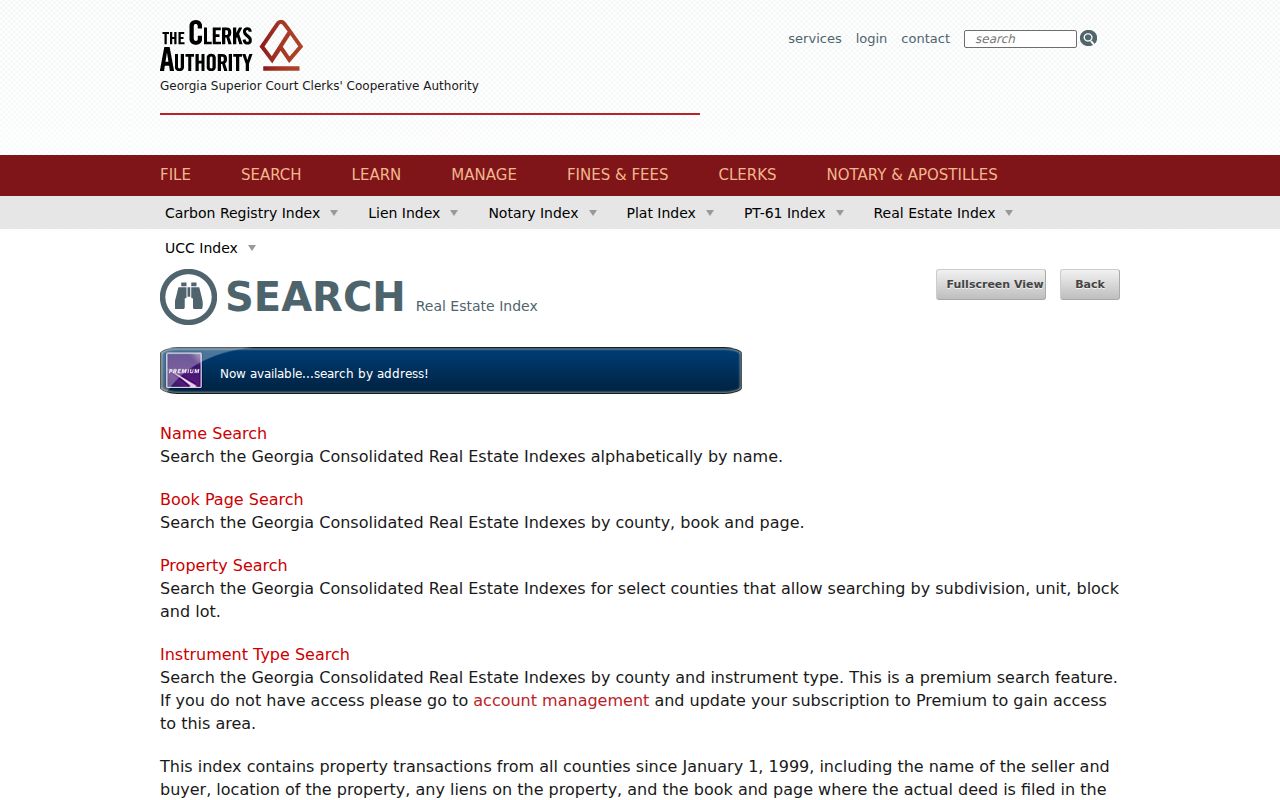
A screen supports the access route. A result still needs party, land, and recording details checked against the deed image itself.
Follow Warren's Grantor-Grantee Index
The grantor gives an interest; the grantee receives it. Begin with a known current conveyance and use those roles to walk the chain backward. This method beats leaning on a sale line or a mailing name pulled from an assessment card.
- Find the current owner's acquisition deed with that owner as grantee, using name or known book/page.
- Read the grantor, legal description, recording date, and capacity from the deed image.
- Search that grantor as a grantee to locate the deed by which the prior party acquired the same land.
- Repeat while the legal description stays aligned. Move to deed books, microfilm, probate, or parent-county sources when the web index ends.
- Grantor
- The party transferring an interest.
- Grantee
- The party receiving an interest.
- Chain of title
- The ordered set of conveyances tied to the same land.
- Book/page
- The recorded placement used to retrieve an instrument.
Plats Support Warren Deeds
A deed may point to a subdivision lot, an acreage tract, a right-of-way, or land described by courses and adjoining owners. It could also touch a right-of-way. Courses and adjoining owners describe other parcels. Search the GSCCCA plat and property route by subdivision, lot, block, owner, surveyor, legal description, or book and page. Subdivision, lot, and block are common starting points. Owner, surveyor, and legal description work too. A GIS field can point toward a plat. The recorded image remains the legal map cross-check.
Warren's subdivision rules recognize a special one-to-five-acre mortgage lot with a 30-foot access easement. Such a lot may carry a survey plat. Yet it can fall outside the definition of a subdivision. That local rule is a good reason to read the instrument. Never assume every recorded lot belongs to a neighborhood plat.
Warren Deed Images and Fees
GSCCCA publishes several access tiers. Limited-use summary searching is free. Single-use access costs $5 for four consecutive hours. Regular access runs $14.95 per month, and premium access is $29.95 per month recurring. Images or prints generally cost $0.50 per page under account terms.
Those are system prices, not a Warren certified-copy fee schedule. The clerk publishes no separate Warren copy and certification charges online. So call 706-465-2262 or visit the counter at 521 Main Street before sending payment. A courthouse terminal is also the best no-subscription route. Use it whenever a web image sits behind a paywall.
Warren Fraud Alert Context
Georgia's FANS property-fraud alert service sends free notices tied to a name, document, or address. GSCCCA counts nearly 85,000 users statewide. Warren County owners can register the same way as anyone else in Georgia. Treat the alerts as a watchtower, not a wall.
An alert simply flags a new filing. It cannot stop a recording, prove fraud, or substitute for reading the deed records themselves. If an unexpected instrument shows up in Warren County land records, contact the clerk. Get legal advice quickly.
Prepare a Warren Deed Request
Write down every citation before you close a search session. A strong Warren County deed request names the county, the document type, party names, and the recording date. It should also carry the full book/page reference. Check the deed for cited instruments too. A plat, easement, assignment, corrective deed, or release may be named in the margins. Each one deserves its own citation. One recorded image may depend on another filing. That filing may explain the legal description or a signer's authority.
Before mailing a copy request, call the clerk. Ask which payment form, return envelope, identification, and certification wording the office requires. The county publishes none of those details. Say whether you need a plain or certified copy. For older deed books, give a narrow date span. Clear terms cut search time. They also help the clerk separate a deed from a security deed or lien filed under the same party names.
Obtain a Warren Deed Copy
Start with the online deed index. Capture the county, party names, instrument type, recording date, and book/page. Viewing an image online may require an account. Without one, take the citation straight to the Warren County Clerk of Superior Court. Ask which copy fits your purpose, plain or certified. The county publishes no mail instructions or certification fees. Confirm both with the clerk before mailing a deed records request.
Older deeds reward extra care. Give the clerk a narrow date span, party name variants, and the full legal description. The archives catalog and the Warren County Library can help identify a record series, but the custodian supplies the official copy. Estate transfers may also require the related probate file and any executor or administrator deed.
Recorded, not guaranteed. Warren deed records show filed instruments, not a title opinion. Unrecorded interests, indexing errors, and unresolved encumbrances can still matter.
Cross-Check Warren County Deeds
A deed rarely stands alone. In Warren County, a full property trail pulls the legal description and recording references apart. Look for a plat, easement, or right-of-way. A prior deed or corrective filing counts too. Then search the same parties and land. Security deeds, assignments, releases, liens, judgments, and lis pendens can all cloud title. Match each release to the instrument it addresses by party, date, and book/page. It may not clear every similar name.
Platted land and rural land demand different search habits. A subdivision deed may speak in subdivision, block, lot, and plat-book terms, while an acreage tract leans on roads, creeks, bearings, distances, survey calls, and adjoining owners. The Warren County parcel schema holds clues. Its fields cover range, section, military survey, township, subdivision, lot, book, page, and several acreage measures. Treat those as leads only. The recorded deed and plat remain the documents to read.
Historic work needs a wider chain. Warren County was created in 1793 from Columbia, Burke, Richmond, and Wilkes counties, so a pre-formation land trail may continue in a parent county's deed records. Courthouse fires in 1853 and 1909 make surviving-series checks essential. Use the Georgia Archives county-card catalog to spot possible microfilm. Then ask the clerk which books survived, were reconstructed, or were indexed later.
Probate can bridge an apparent break. A will, estate administration, heir proceeding, or court order may explain why an executor or administrator signed a deed, so search the probate file and the conveyance together. A shared surname proves nothing, and a restricted death certificate matters less when the transfer is documented in probate and land records.
Disputed title adds a court layer. Foreclosure, quiet-title, partition, lien-enforcement, and lis-pendens matters reach Warren County Superior Court through PeachCourt. Mine the docket for filings and outcomes. Then return to the land index for any deed, release, judgment, or notice recorded against the property.